Featured Author: Stephanie Pilkinton
(follow Stephanie at https://substack.com/@sweetteaandscience)
The San Antonio Breast Cancer Symposium (SABCS) brings together researchers, clinicians, and advocates from around the world to share the latest advances in breast cancer research. Each year, nearly 2,000 scientific abstracts are presented, reflecting progress across all subtypes of breast cancer. SABCS is a unique environment where established experts and emerging investigators come together to challenge assumptions, build on prior discoveries, and explore new approaches to improving patient outcomes.
This year, The IBC Network Foundation was proud to partner with the American Association for Cancer Research (AACR) to support early-career investigators whose work focuses on inflammatory breast cancer (IBC). Through this partnership, five researchers received $1,000 in seed funding to present their work at SABCS and continue developing research dedicated to this rare and aggressive disease. Early funding such as this is often a critical first step toward securing larger NIH grants and advancing promising ideas into meaningful clinical research.
Below are the recipients of this year’s awards and summaries of their research contributions.
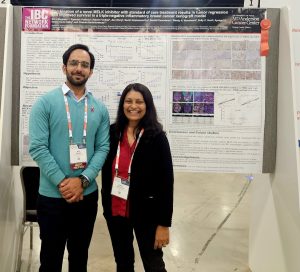
Mohd Mughees, PhD
UT MD Anderson Cancer Center
Combination of a Novel MELK Inhibitor with Standard of Care Treatment Results in Tumor Regression and Improved Survival in a Triple-Negative Inflammatory Breast Cancer Model
Dr. Mughees’ research focuses on MELK, a protein frequently overexpressed in aggressive breast cancers, including triple-negative breast cancer (TNBC) and IBC. His study evaluated whether combining a MELK inhibitor with standard chemotherapy could improve treatment effectiveness. Using a mouse model, the team found that combining the MELK inhibitor MELK-In-30e with eribulin slowed tumor growth, reduced metastatic behavior, and suppressed markers associated with aggressive disease. While preclinical, these findings suggest that MELK-targeted therapies may represent a promising future strategy for TNBC and potentially IBC. Ongoing work aims to validate these findings in human tissue samples.
 Tanu Sharma, PhD
UT MD Anderson Cancer Center
Aurora Kinase A (AURKA) as a Novel Druggable Target in ER-Positive Inflammatory Breast Cancer
Dr. Sharma’s work addresses a significant gap in IBC research: ER-positive IBC. Although ER-positive breast cancers are often considered less aggressive, ER-positive IBC behaves quite differently and is associated with significantly poorer long-term outcomes. This study investigated Aurora Kinase A (AURKA) as a potential therapeutic target. The team evaluated several drugs alone and in combination, finding that alisertib—particularly when combined with the estrogen-targeting therapy fulvestrant—showed promising anti-tumor activity. These results support further exploration of targeted combination therapies specifically designed for ER-positive IBC.
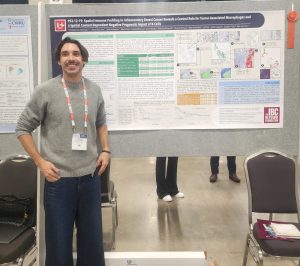 Christophe Van Berckelaer, MD
University of Antwerp
Spatial Immune Profiling in Inflammatory Breast Cancer
Dr. Van Berckelaer presented two studies using artificial intelligence–based imaging to examine the immune landscape of IBC tumors. Rather than analyzing isolated tissue sections, his work evaluated the spatial relationships between immune cells and tumor cells across the entire tumor environment. The research revealed higher levels of CD163+ tumor-associated macrophages in IBC compared to non-IBC, highlighting the immunosuppressive nature of the IBC microenvironment. Importantly, outcomes were more strongly associated with immune cell location than with immune cell quantity alone. These findings suggest new therapeutic strategies aimed at immune reprogramming within the IBC tumor microenvironment.
Ekene Onwubiko, MD
UT MD Anderson Cancer Center
Outcomes After Locoregional Recurrence in Non-Metastatic Inflammatory Breast Cancer
Dr. Onwubiko’s study examined outcomes for IBC patients who experienced locoregional recurrence (LRR) after receiving standard trimodality therapy. Among 140 patients, only nine experienced LRR, confirming that recurrence is uncommon but clinically significant. Most recurrences occurred on the chest wall, typically within 17 months of treatment. Survival following recurrence was poor, underscoring the seriousness of LRR in IBC. Future analyses will focus on radiation treatment planning to determine whether technical factors may contribute to recurrence risk.
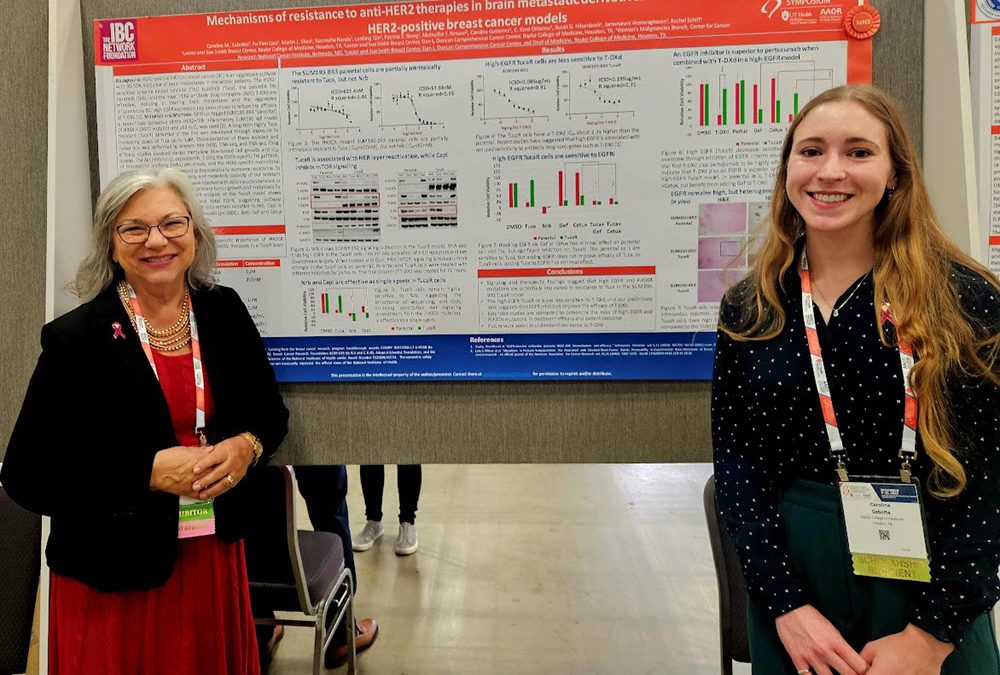
 Caroline Sabotta, BS
Baylor College of Medicine
Mechanisms of Resistance to Anti-HER2 Therapies in Brain Metastatic Inflammatory HER2-Positive Breast Cancer
Ms. Sabotta’s research explored why HER2-positive IBC can develop resistance to therapies such as tucatinib and T-DXd, particularly in the setting of brain metastases. The study found that resistant cancer cells showed high levels of EGFR signaling, which reduced sensitivity to HER2-targeted antibody-drug conjugates like T-DXd. Importantly, the addition of EGFR inhibitors improved treatment effectiveness in resistant models. These findings support further investigation into combination strategies that target both HER2 and EGFR pathways in aggressive HER2-positive IBC.
Looking Ahead
Collectively, these studies highlight the complexity of inflammatory breast cancer and the urgent need for continued, disease-specific research. Each project contributes valuable insight into treatment resistance, immune biology, recurrence, and novel therapeutic strategies. Progress in IBC research depends on sustained funding, collaboration, and advocacy.
The IBC Network Foundation remains committed to supporting research that advances understanding and improves outcomes for patients facing inflammatory breast cancer. By investing in early-career investigators and innovative ideas, we help ensure that IBC remains a research priority and that promising discoveries continue to move forward.