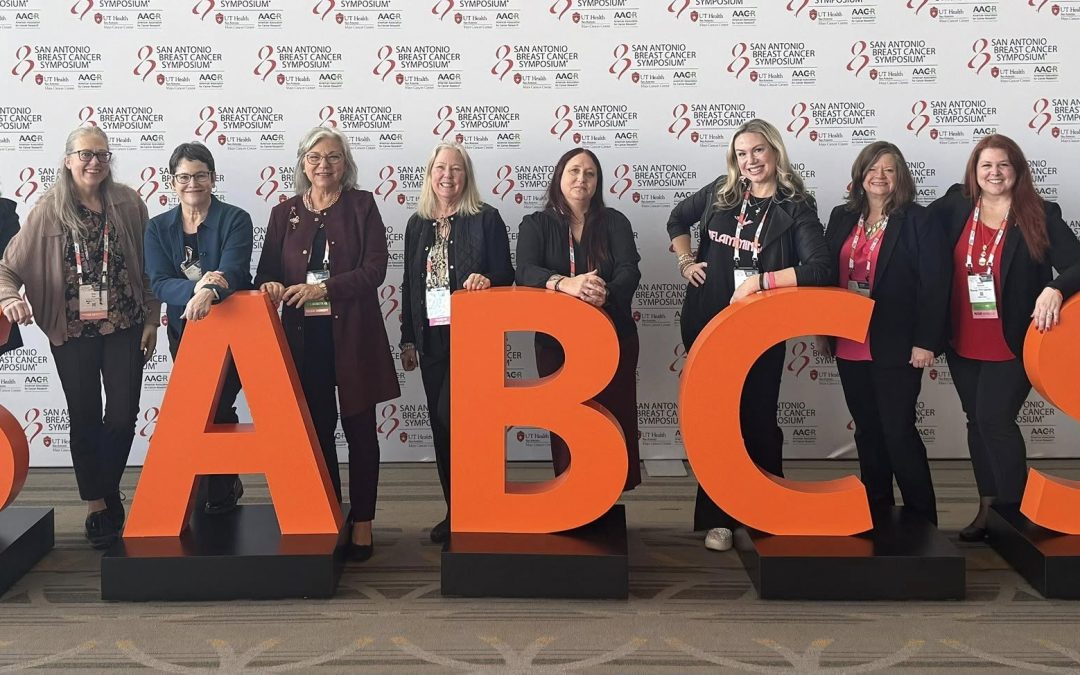
Co authors: Terry Arnold and Stephanie Pilkinton
For the IBC Network Foundation, 2025 became something we never expected to say again so soon: a year of firsts.
Two years ago, we were part of a milestone moment when inflammatory breast cancer was presented on SABCS’s main stage for the first time. That session was selected as the People’s Choice, and I had the honor of serving on that panel alongside Naomi John of the IBC Network UK. It felt like a once-in-a-lifetime breakthrough.
And yet, here we are again — witnessing new doors open.
A Room of Our Own
Just days before the conference began, I received a call from Dr. Wendy Woodward, Head of the Morgan Welch Inflammatory Breast Cancer Clinic at MD Anderson. She told me the SABCS committee had offered her a meeting room.
“Would you like to have it?”
That room became IBC Connect — a small but powerful gathering Dr. Woodward created to bring together institutions and organizations to talk seriously about new collaborative strategies for IBC. Once again, the IBC Network Foundation provided the sponsorship that allowed the technology and presentation to be delivered at the level it deserved.
It was a quiet moment in a massive conference — but one that signaled something important: IBC is no longer waiting for permission to be part of the conversation.
Canada Shows Up
This year marked the first time Danielle Cameron of IBC Network Canada attended SABCS. And the truth is, she almost didn’t come.
As a newly formed nonprofit, every dollar matters. Danielle worried about the cost and believed she could simply watch the sessions online and get the same information. I pushed her — because I knew something she didn’t yet.
SABCS is not just about what’s on the screen.
It’s about who you meet in the hallway. The posters you visit, meeting the passionate scientist in person.
After the conference, Danielle wrote that this was the first meeting she had ever attended where she wasn’t just taking notes — she was building relationships. Instead of passively receiving information, she was becoming part of the research and advocacy ecosystem itself.
That shift — from observer to participant — is what turns knowledge into power.
Turning Grief into Purpose
This year, we also brought something new: a medical writer dedicated solely to focus on inflammatory breast cancer.
Stephanie Pinkerton did not come to us by chance. I first met her ten years ago when she was a nurse standing beside her best friend, Heather Ryan, as Heather battled IBC. Stephanie had never been able to write about that loss — it was simply too painful.
Recently, she retrained as a medical writer and reached out, wanting to volunteer. We invited her to SABCS with one mission: to track down every IBC poster, every researcher, every advance — and bring it back to our community in articles.
While she was there, something shifted. Surrounded by scientists, advocates, and patients all working to make this disease better, Stephanie found that her grief changed shape. It didn’t disappear — but it became action.
Now, her voice will help carry the story of IBC forward.
Funding the Next Generation
For the first time, the IBC Network Foundation partnered with The American Association of Cancer Research (AACR) to offer Young Investigator Scholarships. We funded five researchers — including one from Belgium — helping early-career scientists gather the data they need to publish, present, and stay in this field.
A $1,000 grant can be the difference between an idea that fades and a discovery that grows. These awards help researchers generate early data, strengthen applications for larger grants, and continue advancing IBC-specific research.
The funded studies included:
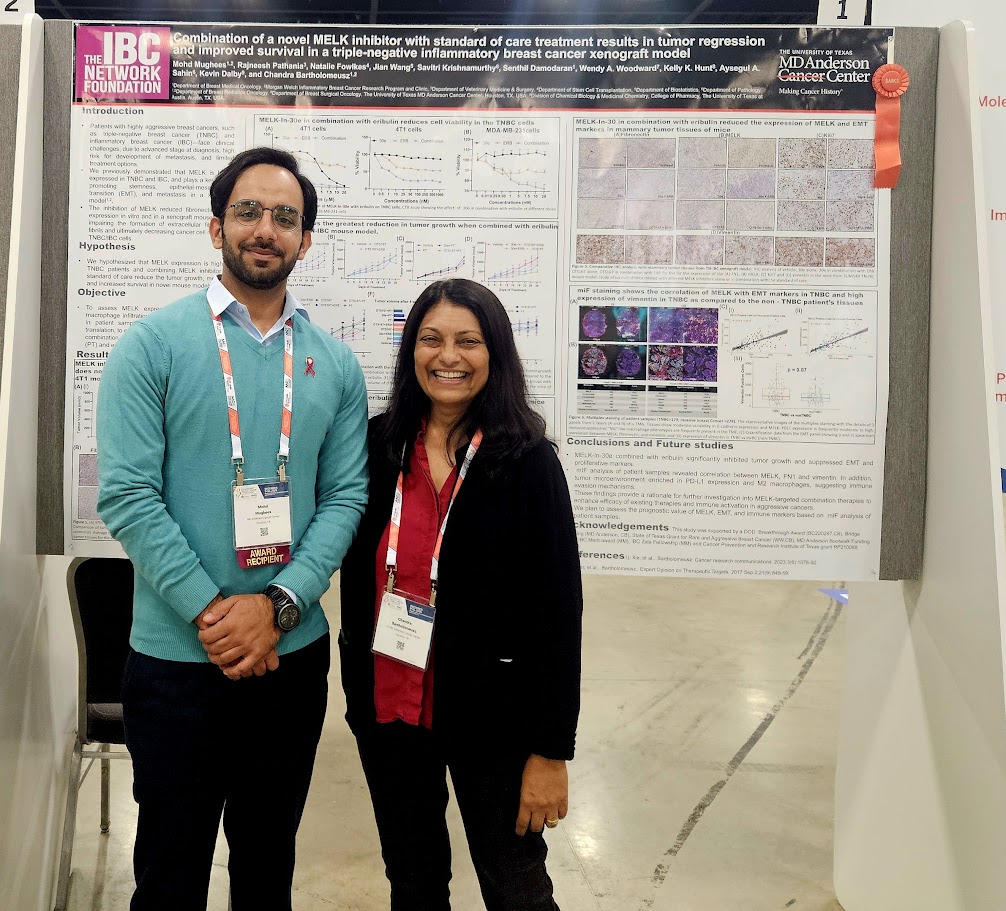
Mohd Mughees, PhD (UT MD Anderson Cancer Center)
Dr. Mughees studied a protein called MELK, which is commonly active in aggressive breast cancers. His research showed that combining a MELK inhibitor with standard chemotherapy slowed tumor growth and reduced metastatic behavior in triple-negative inflammatory breast cancer models.
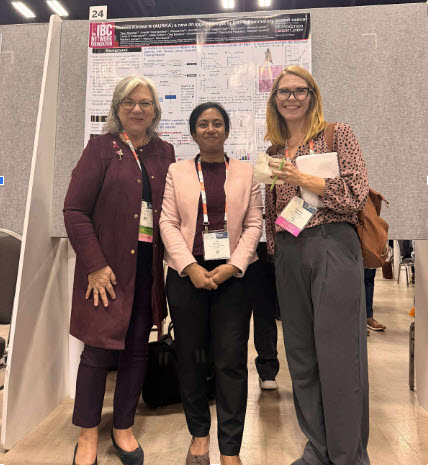
Tanu Sharma, PhD (UT MD Anderson Cancer Center)
Dr. Sharma focused on ER-positive IBC, an understudied but highly aggressive subtype. Her work identified Aurora Kinase A (AURKA) as a potential new treatment target and demonstrated that combining the AURKA inhibitor alisertib with hormone therapy may offer a more effective treatment approach.
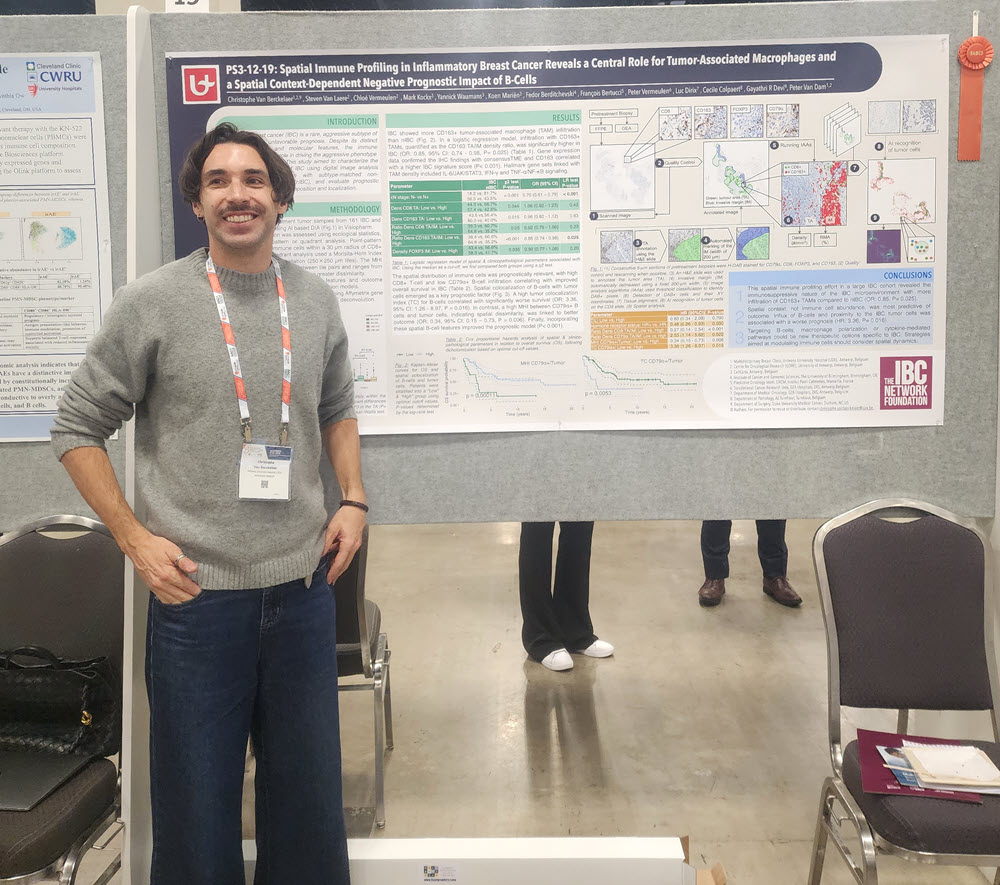
Christophe Van Berckelaer, MD (University of Antwerp)
Dr. Van Berckelaer used artificial intelligence–based imaging to study the immune environment of IBC tumors. His findings revealed that immune cell location plays a major role in outcomes, highlighting the immunosuppressive nature of the IBC tumor microenvironment.
Ekene Onwubiko, MD (UT MD Anderson Cancer Center)
Dr. Onwubiko examined outcomes in IBC patients who experienced locoregional recurrence after standard treatment. While recurrence was uncommon, survival after recurrence remained poor, emphasizing the need for continued refinement of treatment strategies.
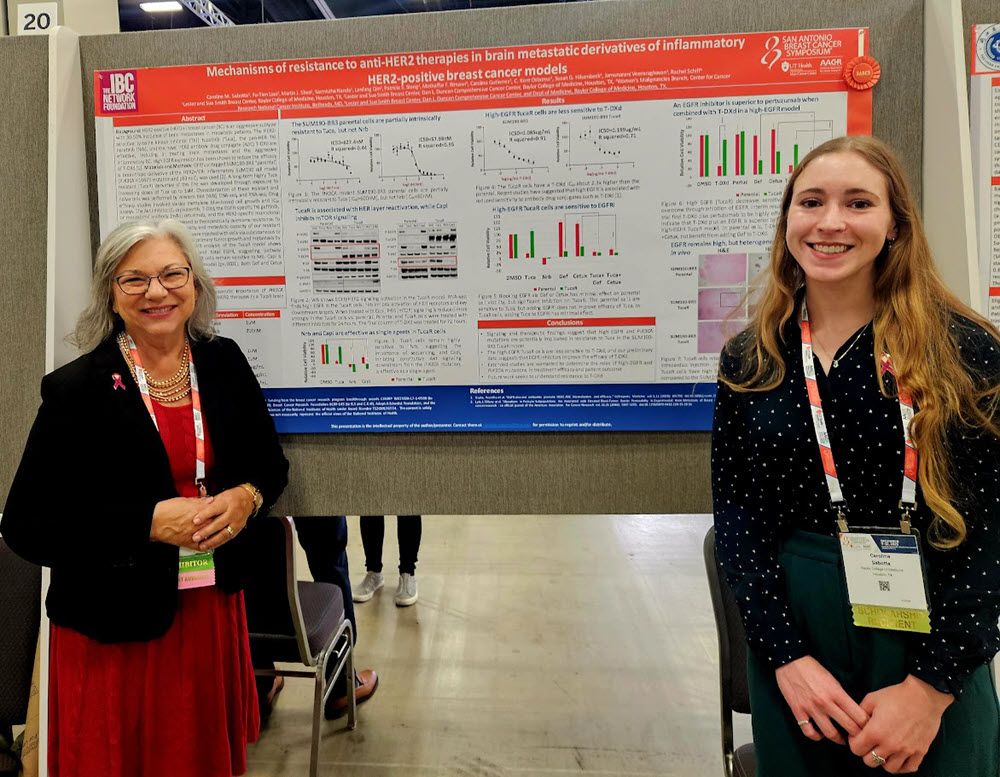
Caroline Sabotta, BS (Baylor College of Medicine)
Ms. Sabotta investigated why some HER2-positive IBCs become resistant to therapies like tucatinib and T-DXd, particularly after spreading to the brain. Her work suggests that targeting additional growth pathways, such as EGFR, may help overcome treatment resistance.
This is how advocacy becomes science.
The People Who Make It Happen
None of this happens without the people who show up.
From Staci, who kept everyone on schedule in a conference of 11,000 people, to Caroline, Carrie, AKA The Goddess, who held down the booth so others could attend sessions, to volunteers giving rides to exhausted advocates, to Rachel asking hard questions at pharma booths, to Meade Hartfield sharing with all about the documentary Inflamingo, to Alisa, sharing what she learned through her scholarship via the Alamo Program, and to Carol Mikel, our newly appointed Executive Director, who carried both the organization and the people behind it.
It is exhausting. It is emotional. And it is deeply meaningful.
Looking Forward
Every year at SABCS, something grows.
My dream is that one day there will be a four booths that reads:
IBC Network USA
IBC Network UK
IBC Network Canada
IBC Network Australia
Because these organizations already exist. The science is coming. The community is rising.
And someday, when people hear the words inflammatory breast cancer, they won’t ask, “What is that?”
They will ask, “How do we cure it?”
That is the milestone we are working toward — together.
Thank you for being part of the community that makes moments like this possible.